
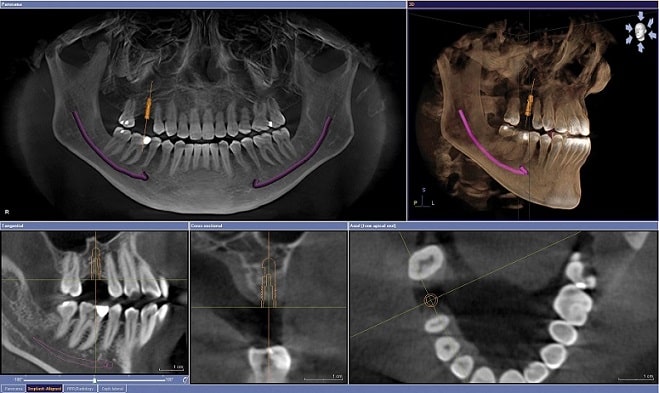
A thorough and in-depth dental exam takes about one hour and includes state of the art 3D imaging and high-resolution photos of all the teeth. Why? Well, would you consider getting a knee or hip replacement without an MRI or a CT Scan? Probably not.
Similarly, a proper and extensive dental exam should be taken seriously. We use advanced technology and 3D imaging because this gives you a correct diagnosis with no margin for error.
It also ensures that you are totally informed of all of your treatment options.
Another important aspect to consider is that a 3D CT scan provides a three-dimensional image of the mouth. This is much more detailed than traditional, flat dental x-rays such as bitewings or a panoramic scan.
A 3D scan is fast and provides a higher degree of information for a superior standard of care.
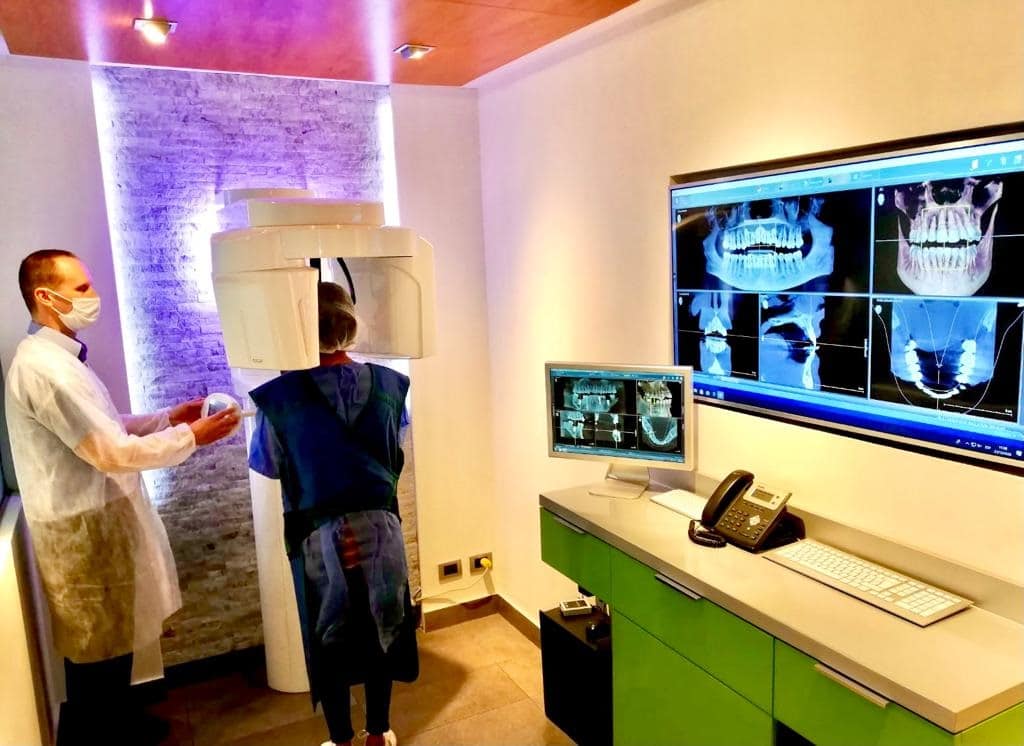
We have integrated 3D tomography scanning in our clinic
The scanning process takes less than 10 seconds and provides our doctors with three-dimensional, cross-sectional views of existing teeth, bone, and nerves.
Of course, if you are looking for dental implants and surgical procedures, then 3D scanning is even more important. This scan takes just a few short moments to load and is soon ready for diagnosis.
The specially integrated software allows our specialist to check the best areas of bone for implant placement. If bone graft and tissue regeneration are needed, it’s decided with the use of these images.
The software also allows us to place virtual implants, choosing their length, diameter, and exact position.
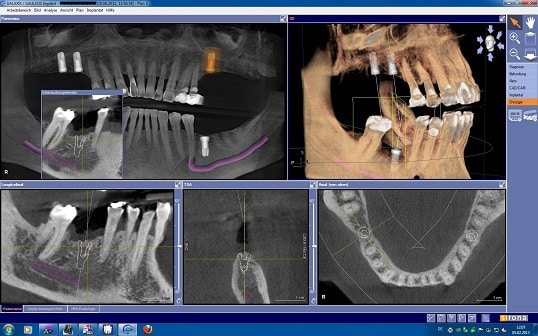
We personalize every treatment plan and can offer different options if the first doesn’t fit with your plans.
Advantages of 3D CT scanning
1️⃣ Examine cross-sections of the patient’s bone to assess bone quality, available volume, and density for stable implant support
2️⃣ Identify all viable treatment options, including the key risk factors for each approach based on the individual case
3️⃣ Check for abscesses, infections, bone loss, or other hidden issues that need to be treated before placing implants
4️⃣ Plan the exact implant position, angle, and depth for the safest, most predictable outcome
5️⃣ Select the ideal implant type, diameter, and length based on the patient’s anatomy and treatment goals
6️⃣ Map and protect sensitive structures like nerves and the sinus cavity to reduce complications
7️⃣ Provide detailed 3D guidance for a more precise, conservative procedure ✅
8️⃣ Use lower radiation than a conventional medical CT scan ☢️
Contact SurgeryinPeru on WhatsApp
📞 Call us: +51 922 435 001
📲 Write to us on WhatsApp for available appointment times
🌐 Fill out our online consultation form
Check out our Google profile for patient reviews and to see we are a serious, reputable company.
I’m Lloyd — message me directly and I’ll coordinate everything for your treatment.


1️⃣ ❓ What is a 3D tomography scan in dentistry (CBCT)?
A 3D tomography scan, also called CBCT, is a specialized dental scan that creates a detailed 3D view of your teeth, bone, nerves, and sinuses. It helps the dentist plan treatment with much higher precision than regular 2D X-rays.
2️⃣ ❓ When is a 3D scan recommended?
It’s commonly recommended for dental implants, impacted wisdom teeth, root canal cases with complex anatomy, jawbone evaluation, orthodontic planning, and investigating infections or hidden bone loss.
3️⃣ ❓ Why is CBCT better than a normal dental X-ray for some cases?
A 2D X-ray flattens structures, so important details can be missing. CBCT shows depth and exact anatomy, which improves diagnosis and planning and helps avoid surprises during treatment.
4️⃣ ❓ Does a 3D scan help make treatments more conservative?
Yes. Because we can measure and plan precisely, we often avoid unnecessary drilling or exploration. This supports a more conservative approach by targeting only what truly needs to be treated.
5️⃣ ❓ How does CBCT improve dental implant planning?
It allows the dentist to evaluate bone height, width, and density, and locate nerves and sinuses. This helps choose the safest implant position, size, and depth for a predictable result.
6️⃣ ❓ Can CBCT detect infections or abscesses that a normal X-ray might miss?
In many cases, yes. CBCT can reveal hidden abscesses, bone defects, fractures, or lesions that may not be clear on a 2D image.
7️⃣ ❓ Is a 3D dental scan safe? What about radiation?
CBCT typically uses less radiation than a medical CT scan, and the scan is very fast. Your dentist will only recommend it when it adds real value to diagnosis or treatment planning.
8️⃣ ❓ Does the scan hurt, and how long does it take?
It’s painless and non-invasive. The scan takes just 10 seconds and you simply stay still while the machine rotates around your head.
9️⃣ ❓ Can pregnant patients get a CBCT scan?
If you are pregnant or think you may be, tell the clinic before any imaging. In most situations, elective scans are postponed, and your dentist will choose the safest option based on urgency.
🔟 ❓ Do children ever need a CBCT scan?
Sometimes, yes, especially for impacted teeth, orthodontic planning, or unusual anatomy. The decision is always case-by-case, using the lowest necessary exposure.
1️⃣1️⃣ ❓ Can CBCT help with wisdom tooth extractions?
Yes. It shows how close the roots are to the nerve canal and helps plan a safer extraction, which can reduce the risk of nerve-related complications.