

Hair transplantation can restore hair in selected areas by moving follicles from a donor area of the scalp. The right plan depends on the cause and pattern of hair loss, the available donor hair, your health and your expectations.
A consultation with one of our specialists is needed to determine whether surgery is appropriate and what result may be realistic for you.
Which surgeon should you choose in Lima?
The best first step is a conversation and a professional evaluation. This helps you understand how we work, what results are realistic for your anatomy, and what level of service and follow-up you can expect.
Our plastic surgeons in Lima:

1️⃣ Dr. Daniel Saco-Vertiz
Specialized plastic surgeon
CMP 49075 | RNE 34624 | Chacarilla, Surco location

2️⃣ Dra. Maria Eugenia Ruiz
Specialized plastic surgeon
CMP 29662 | RNE 15710 | Monterrico, Surco location
What is a hair transplant?
A hair transplant is a surgical procedure that moves hair follicles from a donor area, usually at the back or sides of the scalp, to areas with thinning or hair loss.
FUE and FUT describe how donor follicles are harvested:
- FUE, or follicular unit excision: follicles are removed individually using small punches. This avoids a single linear incision, but can leave small dot-shaped scars.
- FUT, or follicular unit transplantation: a strip of scalp is removed from the donor area, and follicular units are prepared from it. This leaves a linear scar.
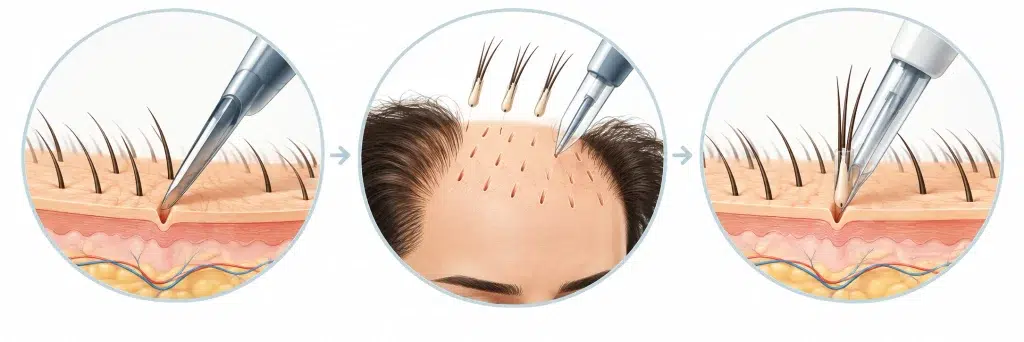
After harvesting, grafts are placed into small openings in the recipient area. The physician may use forceps or an implanter, depending on the surgical plan.
What does DHI mean?
Some providers use “DHI,” short for “direct hair implantation,” to describe placing extracted grafts with an implanter. This is a graft-placement method, usually used with FUE harvesting. It does not describe a separate way of harvesting donor hair.
An implanter does not make the procedure incision-free. Grafts still need to be placed into small openings in the scalp. The choice of placement tools depends on the surgeon’s plan and the patient’s needs.
Who may be a candidate?
Hair transplantation may be considered for some people with pattern hair loss, but it is not suitable for everyone. The physician needs to assess the likely cause of hair loss, its progression, the quality and capacity of the donor area, scalp health and your medical history.
A transplant redistributes existing hair. It does not stop future hair loss in untreated areas. Your doctor may discuss medical treatment or other ways to manage ongoing hair loss as part of a longer-term plan.
Consultation and planning
During an evaluation, the physician may:
- Review your medical history and the history and pattern of your hair loss.
- Examine your scalp and donor area.
- Discuss your goals, hairline design and expected coverage.
- Explain the appropriate hair-harvesting and graft-placement options.
- Estimate the number of grafts and sessions based on your individual case.
- Review the procedure, anesthesia, recovery, possible risks and costs.
The number of grafts should be determined after an examination. A high graft count is not automatically appropriate. The donor supply and its long-term preservation also matter.
What happens during the procedure?
Hair transplantation is performed with local anesthesia. Sedation may also be considered for some patients, depending on the medical plan. It should not be assumed that every patient will be asleep during the procedure.
The length of the session varies according to the treatment plan and number of grafts. Your medical team will explain what to expect before surgery, including preparation, anesthesia and post-operative care.
Recovery and results
Recovery varies between patients and depends on the procedure and the instructions provided by the medical team. Your scalp may have small scabs or tenderness during the early healing period. Follow your surgeon’s instructions about washing, activity, medications and follow-up visits.
It is common for transplanted hairs to shed during the first few weeks. New growth often begins after several months. Results develop gradually, and the full outcome may take around 10 to 18 months to assess.
Also, results cannot be guaranteed. Transplanted hair may last long term, but natural hair loss can continue in other areas. Some patients may need ongoing treatment or further procedures.
Possible risks and limitations
Hair transplantation is surgery and has risks. These may include bleeding, infection, swelling, discomfort, scarring, changes in scalp sensation, poor graft growth, an unnatural-looking hairline or thinning of the donor area. A physician should explain the risks relevant to your case before you decide.
FUE does not mean “scarless,” and implanter-assisted placement does not mean “incision-free.” The surgeon should explain where scars may occur and how the donor area will be managed.

📩 Contact Us for a Personalized Evaluation
📞 Call us: +51 922 435 001
📲 Write to us on WhatsApp
🌐 Fill out our online consultation form to request your appointment
📍 Available in our two surco branches, district of Lima, Peru.
Check out our Google profile for patient reviews and to see we are a serious, reputable company.
I’m Lloyd — message me directly and I’ll coordinate everything for your treatment.

Hair Transplants – Frequently Asked Questions ❓

❓ What is the difference between FUE and FUT?
FUE and FUT describe different ways of harvesting donor hair. FUE removes follicles individually and may leave small dot-shaped scars. FUT removes a strip of scalp and leaves a linear scar. The physician can explain which method may be appropriate for your case.
❓ What does DHI mean in hair transplantation?
Some providers use “DHI” to describe placing extracted grafts with an implanter. It refers to a graft-placement method, usually used with FUE harvesting, rather than a separate way of harvesting donor hair.
❓ Does DHI avoid incisions?
No. Implanter-assisted placement still involves placing grafts into small openings in the scalp. It should not be described as incision-free.
❓ Does FUE leave scars?
Yes. FUE avoids a single linear scar, but small dot-shaped scars may remain in the donor area. Their visibility depends on factors such as the number and distribution of extractions, healing and hairstyle.
❓ Will transplanted hair fall out?
The transplanted hairs commonly shed during the first few weeks. New growth usually appears after several months, and results develop gradually. Natural hair loss can continue in untreated areas.
❓ How many grafts will I need?
There is no fixed number for everyone. The physician estimates the number after assessing the area to be treated, donor supply, hair characteristics and long-term plan.
❓ How long does it take to see the results?
New growth often starts after a few months. The final result may take around 10 to 18 months to assess, and timing varies between patients.
❓ Is a hair transplant permanent?
Transplanted hair may last long term, but results cannot be guaranteed for every patient. Hair loss can progress in other areas, so some people may need ongoing treatment or additional procedures.
❓ Is hair transplantation safe?
Hair transplantation is surgery and has potential risks. A physician should assess your health and explain the possible benefits, limitations and risks for your particular case before you decide.