

If you are missing most or all of the teeth in your upper or lower jaw, an implant-supported full-arch bridge may be one option to discuss with a dental professional. All-on-4 and All-on-6 are terms commonly used for a fixed bridge supported by four or six dental implants in one jaw.
If you’re exploring other tooth-replacement options, read more about dental implants in Lima. This page covers dental implant treatment more broadly.
The right option depends on your oral health, bone structure, bite and the type of teeth planned. A consultation and 3D dental scan help the dental team assess your case and explain which treatment options may be suitable.
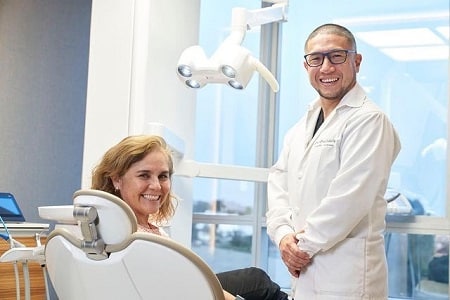
Dr Alfredo Zuiko is our specialist in maxilofacial surgeries and dental implants
What is the difference between All-on-4 and All-on-6?
The main difference is the number of implants used to support the full-arch bridge:
- All-on-4 uses four implants in one jaw.
- All-on-6 uses six implants in one jaw.
The number of implants alone does not determine which option is better. The dentist or maxillofacial surgeon considers factors such as available bone, implant position, the shape of the jaw, bite forces and the design of the bridge.
In some treatment plans, additional implants may be appropriate. In others, four may be sufficient.

This is an all-on-4 dental implants treatment with a hybrid, fixed over-denture.
How is the right option chosen?
Planning typically includes an examination of your mouth and a review of your dental and medical history. A 3D dental scan, also known as a CBCT scan, helps show the bone and other structures in the area being treated.
Learn more about 3D dental implant planning in Lima.
The dental team uses this information to assess:
- How much bone is available and where it is located
- Whether any teeth need to be removed
- The position and number of implants required
- The type and design of the planned bridge
- Whether additional procedures, such as bone grafting, may be needed
Your consultation should include a discussion of the proposed treatment, its stages, expected costs and any alternatives.
What happens during treatment?
Treatment may involve several stages:
- Examination and treatment planning, including imaging when needed.
- Implant placement, with tooth removal or other procedures if indicated.
- Healing while the implants integrate with the bone.
- Placement or adjustment of a provisional bridge, if appropriate for your case.
- Fitting of the final bridge once the dental team confirms you are ready.
Some patients may qualify for a provisional fixed bridge soon after implant surgery. This depends on clinical findings and implant stability at the time of treatment.
It cannot be guaranteed in advance. In other cases, the dental team may recommend a healing period before attaching the bridge. Treatment can also take longer if extractions, bone grafting or other procedures are needed.

This patient required an all-on-6 dental implants, upper side only as he already had strong teeth in the lower side.

However, the patient of this x-ray chose to place eight upper side implants for additional support and strength. This is a good option for patients with sufficient bone density, height, and width.
Is All-on-4 or All-on-6 better for me?
Neither option is best for everyone. The number and placement of implants should be planned around your anatomy and the restoration being made. More implants do not automatically mean a better result, and the final plan needs to be based on a clinical assessment.
At this first appointment, we perform the planning with 3D x-rays. This can be followed by implant placement as we have already selected the type of implant, angle of each, and options of fitting the prosthetic.
Sedation and anesthesia is often used to ensure patient comfort during the surgery.

Our 3D in-house x-rays are used for all treatment diagnosis, whether it be for 1 implant, or a full mouth.
In conclusion: All-on-6 is very similar to All-on-4. The difference being that All-on-6 involves the same implant placement, but with six implants per arch for added stability. The additional implants may require a little more time for surgery. However, they provide enhanced support and durability for the prosthetic teeth.

Dr Jung Song Park (center) & Dr Daniel Yuen (right) are our specialists in dental implants.
📩 Contact Us for a Personalized Evaluation
📞 Call us: +51 922 435 001
📲 Write to us on WhatsApp
🌐 Fill out our online consultation form to request your appointment
Check out our Google profile for patient reviews and to see we are a serious, reputable company.
I’m Lloyd — message me directly and I’ll coordinate everything for your treatment.

❓FAQs about Dental Implants in Lima

❓ Can I receive fixed teeth on the same day as implant surgery?
Some patients may be suitable for a provisional fixed bridge soon after surgery. This depends on the clinical assessment and implant stability. Your dental team will confirm whether this is appropriate for you.
❓ Does All-on-6 always last longer than All-on-4?
No specific number of implants guarantees a longer-lasting result. Long-term outcomes also depend on the treatment plan, oral hygiene, regular maintenance and individual health factors.
❓ Will I need a bone graft?
Not everyone needs a bone graft. The dental team assesses the amount and location of available bone using an examination and imaging, then explains whether additional procedures are recommended.
❓ How long does full-arch implant treatment take?
The timeline varies. It depends on your oral health, the procedures required and when your implants are ready to support the planned bridge. Your dental team should explain the expected stages after assessing your case.
❓ Can international patients have this treatment in Lima?
International patients can arrange an assessment in Lima. Because treatment may require more than one stage or visit, discuss your travel dates and follow-up needs with the dental team before making plans.